DOLAR41,1913%
EURO48,3102%
STERLİN55,6719%
YEN0,0010%
FRANK51,5910%
ONS3,587,31%1,18
ALTIN4,756,89%1,39
ÇEYREK7,777,52%1,39
CUMHURİYET32,239,00%0,07
BIST1.485,00-0.45%










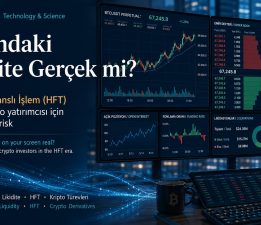
In crypto derivatives markets, the order book (the screen showing queued buy and sell orders at different prices) can make investors believe that strong liquidity is available. Yet High-Frequency Trading (HFT) systems can submit, change or cancel orders faster than humans can react. Research indicates that HFT may improve liquidity (the ability to buy or sell an asset without causing a major price disruption) and reduce certain forms of manipulation under normal conditions. At the same time, speed advantages and liquidity that can withdraw during market stress create a hidden risk, particularly for leveraged crypto traders.
A leveraged crypto trader will often look at two things before opening a position: the price chart and the order book. When large buy orders appear on the screen, they may seem to offer protection if price begins to fall. In modern electronic markets, however, a visible buy order is not necessarily a reliable exit route when the market starts moving rapidly.
At the centre of this question is High-Frequency Trading (HFT). HFT refers to the use of computer algorithms that submit, modify and cancel large numbers of orders at extremely low latency, meaning with almost no delay. These systems can react to small changes in the market within milliseconds, long before a human investor is able to make a decision.
The effect of HFT is not entirely negative. A 2022 study by Shahadat Hossain examined data from 149 London Stock Exchange-listed shares between 2005 and 2016. The research reported that increasing HFT activity was accompanied by improved liquidity in the European market studied. In other words, fast algorithms may make buying and selling easier and may reduce trading friction during ordinary market conditions.
But the same study also delivered a more uncomfortable message for investors. Measuring HFT behaviour by observing only the best bid and offer (the highest visible buying price and the lowest visible selling price) was found to be insufficient. A measure based on the first five price levels of the order book identified HFT activity more effectively. Put simply, a large buy wall at the top of the screen may not tell investors how resilient the market really is.
The danger becomes more important when markets are under stress. A study by Anatoly B. Schmidt focusing on institutional foreign exchange markets argues that the central concern surrounding HFT may not simply be volatility (rapid and significant price movement), but liquidity risk. The paper notes that some fast traders can behave like market makers (participants that continuously post buy and sell orders to help trading occur) in ordinary conditions, while withdrawing during sharp price jumps.
For crypto derivatives investors, that distinction may be critical. A derivative is a contract whose value depends on the price of an underlying asset, such as Bitcoin. Many crypto derivatives traders also use leverage (the ability to open a position larger than the cash deposited as collateral). If liquidity suddenly weakens, a stop order may not execute at the expected price. The spread (the difference between the buying price and the selling price) may widen sharply, causing the position to close at a much worse level. When losses exceed required limits, liquidation (the forced closure of a leveraged position by the trading platform) may follow.
Speed can also matter before an order disappears. A study by Gaia Balp and Giovanni Strampelli discusses how faster market-data access and technology positioned closer to trading infrastructure can allow HFT firms to process information before slower investors. The authors argue that this may create a two-tier information environment, where faster systems react to market-moving information before ordinary participants can respond. For investors, this raises a simple but difficult question: is the price on the screen still an opportunity, or have the fastest systems already moved ahead of it?
Even so, it would be inaccurate to describe all HFT activity as manipulation. A study commissioned for the UK Government Office for Science examined 22 stock exchanges between 2003 and 2011. It reported that markets with significant HFT presence experienced fewer suspected cases of end-of-day price manipulation (trading intended to artificially influence a market’s closing price). In the most conservative estimate, the number of suspected monthly cases fell by 27.85, equivalent to a 77.8 percent reduction relative to the sample average.
That finding has clear limits. The study addressed only one specific type of suspected manipulation involving closing prices. It did not establish that HFT always protects investors, prevents liquidity withdrawal during market shocks or eliminates liquidation risks in crypto derivatives markets.
For crypto investors, the real lesson is more balanced and more important: visible liquidity is not always the same as dependable liquidity. A deep-looking order book can create confidence, but the more important question is whether those orders will remain when the market moves sharply and traders urgently need to exit.
In leveraged markets, the most dangerous moment may not be when the price starts falling. It may be the moment an investor discovers that the exit shown on the screen is no longer there.
Editorial Source Note: This original article is based on four uploaded academic research and review documents. Hossain’s study reports that an HFT measure based on the first five order-book price levels identifies HFT activity more effectively than one based only on the best visible prices, while also observing liquidity improvement alongside rising HFT activity in the market studied. Schmidt argues that liquidity withdrawal during stressed conditions may be a more important HFT-related risk than volatility alone in institutional foreign exchange markets. Balp and Strampelli discuss how speed and market-data advantages may create informational inequality for slower investors. Cumming, Zhan and Aitken report an association between HFT presence and fewer suspected end-of-day price manipulation cases across 22 stock exchanges. Most of these studies concern equity and foreign exchange markets rather than cryptocurrency exchanges; their findings are used here to explain relevant market-structure risks, not as direct proof of outcomes in crypto derivatives trading.
This news/article is provided for informational purposes only. The analyses, comments, and evaluations contained herein do not constitute investment advice or financial recommendations. Trading and investing in financial markets involve risk. Readers are advised to make investment decisions based on their own research and, where appropriate, with guidance from licensed financial professionals.